THE INSTALLATION
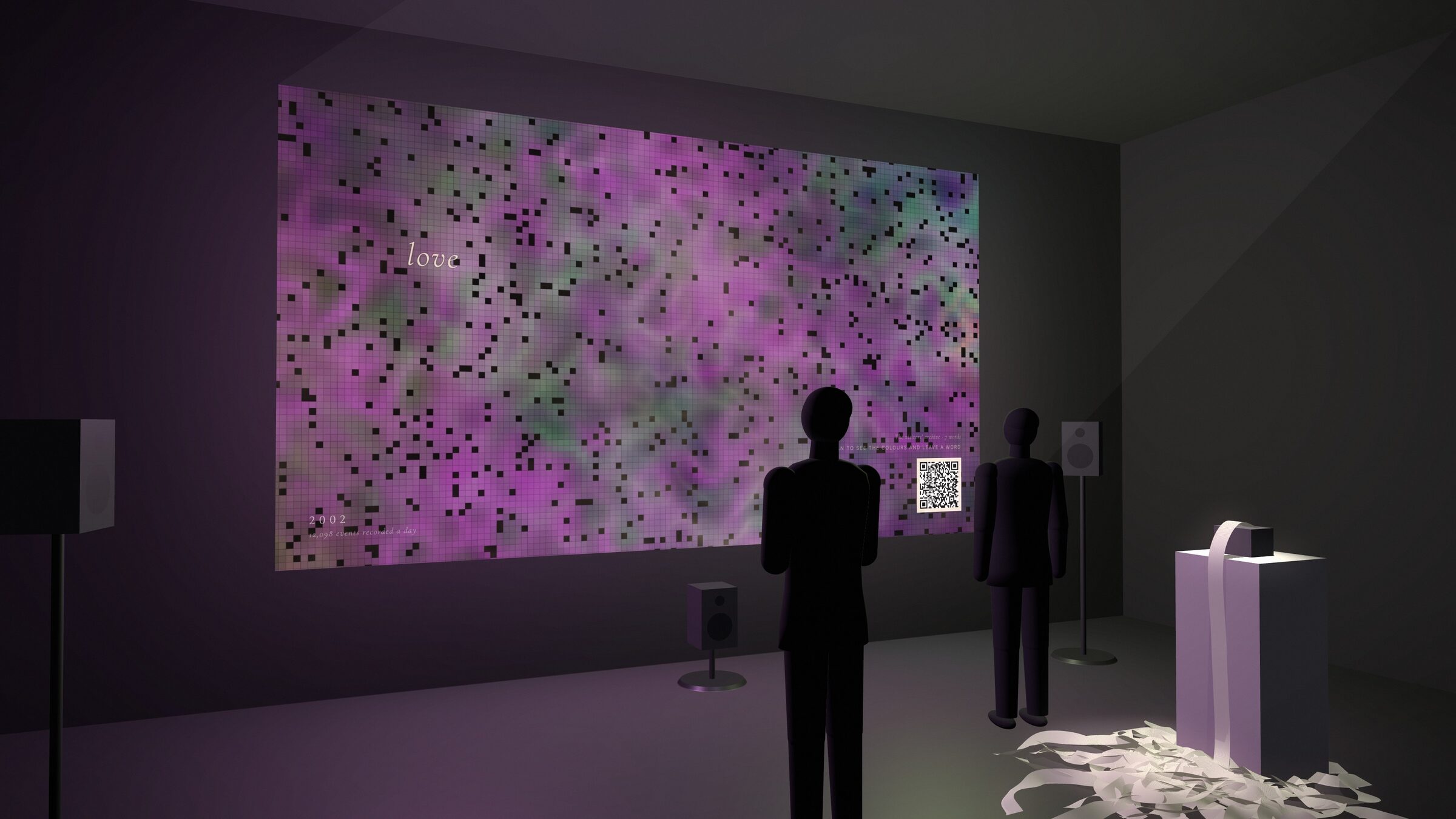
The Second Atmosphere sets two archives side by side. One is GDELT, a record of world events that machines have compiled from news reports since 1979. The other is kept by visitors, who leave one word for the day and say whether it feels heavy or light.
The machine record becomes a projected field of colour and sound that travels through the same moment in every year since 1979; where reporting was thin, the image breaks into gaps. The visitors’ words form a warm sixth light that runs through those gaps. After the present, the field carries the trends forward into five unrecorded years until they come apart. A printer records every year and every word on paper that gathers on the floor.
- Title
- The Second Atmosphere
- Artist
- Robert Sherwood Duffield (Australia, b. 1955)
- Year
- 2026
- Medium
- Generative audiovisual installation: real-time projection, four-channel sound, thermal printer, visitors’ phones
- Duration
- Continuous; one complete cycle every 15 minutes
- Dimensions
- Variable; room about 8 × 6 m, projected image 5.0 × 2.8 m
- Data
- The GDELT Project, 1979 to the present
see the gallery version liveback to the work
TWO ARCHIVES
The first archive is GDELT, the Global Database of Events, Language and Tone. Software reads broadcast, print and web news and records each reported event: who acted, towards whom, how it is classed, and how it was reported. It is an institutional record of the world as the news reported it, reaching back to 1979.
The second archive is written in the room. Visitors scan a QR code and leave one word for the day, and say whether the day feels heavy or light. It records first-hand experience rather than reported events. The work does not claim to show what humanity thinks or feels. The colour field is an artistic interpretation of mediated events, and the visitors’ words add personal responses beside it. The difference between the two records is the subject of the work.
HOW THE ARCHIVE IS READ
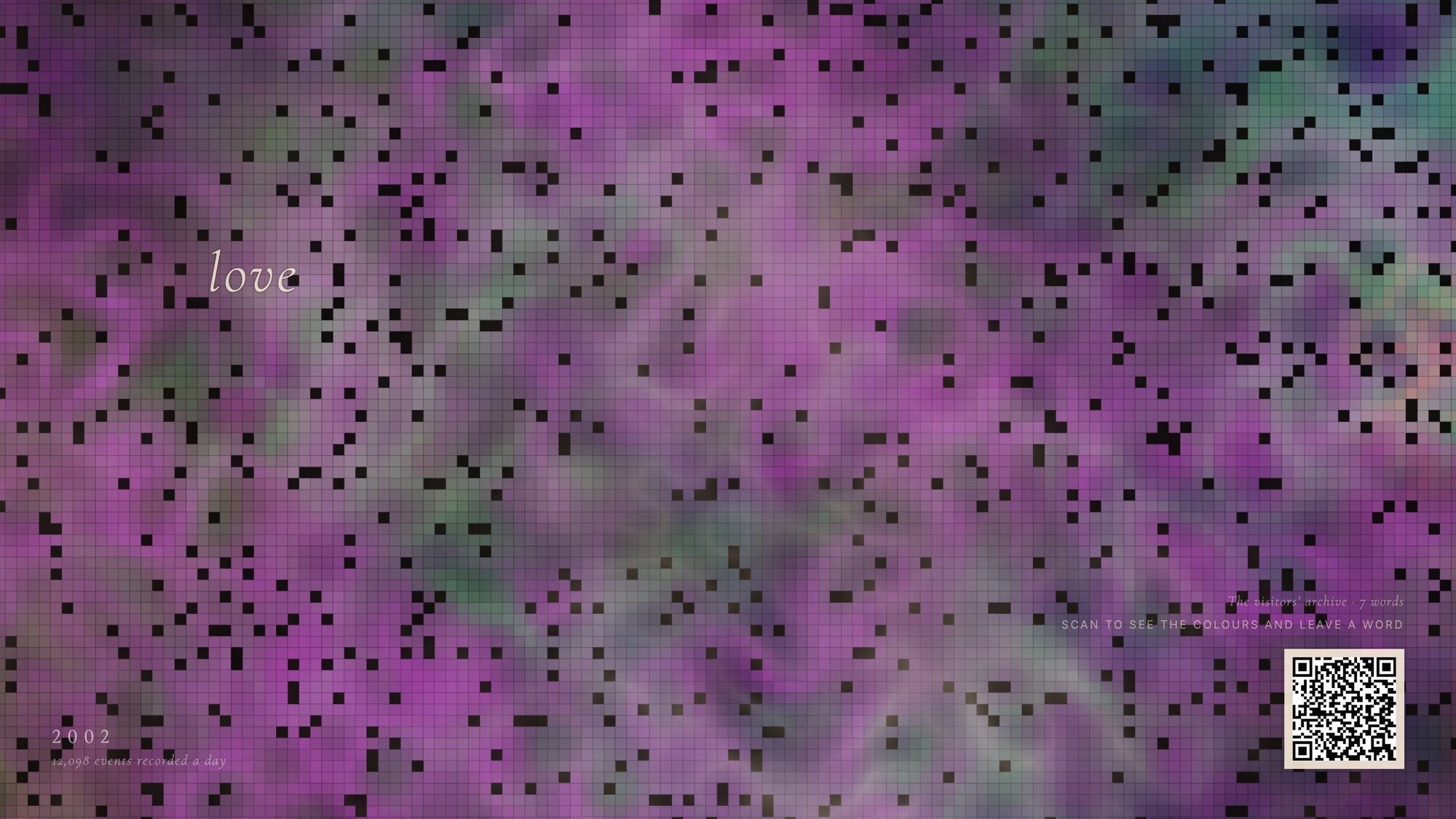
Every fifteen minutes, as GDELT publishes new data, the work opens on the present. It then passes through the same moment in every year since 1979, about 17 seconds per year, with the year shown at the lower left.
- What each year is
- From 1979 to 2014, the same calendar day, from GDELT’s daily archive; from 2015, the same fifteen minutes, from its 15-minute archive.
- What is measured
- Five figures for that moment: how many events were recorded, and the shares classed as verbal cooperation, material cooperation and conflict, with their average rating on the Goldstein scale from −10 (destabilising) to +10 (stabilising). Each drives one colour field and one voice in the sound.
- Against what
- Each year is measured against an ordinary day of the same year, so a colour shows how that moment differed from its own time.
REPORTING, NOT EVENTS
GDELT holds about 1,200 events a day for 1979 and about 177,000 for 2015. That growth mostly reflects more sources and digitised news, not a more eventful world. Because each year is measured against its own ordinary, the growth does not brighten later years. It is shown as the image’s density instead: in thin years the field breaks into a coarse grid with empty cells where nothing was recorded, and it fills as coverage grows.
THE VISITORS’ ARCHIVE
- What is kept
- Each word, with the time, whether the day felt heavy or light, and whether it was left in the gallery or online. No name, address or account.
- How it appears
- Each new word surfaces in the field for a few seconds. Together the words form a sixth light in warm lamplight, outside the five digital colours, drawn over the gaps in the machine archive, so that in the early years it runs exactly where nothing was recorded.
- On paper
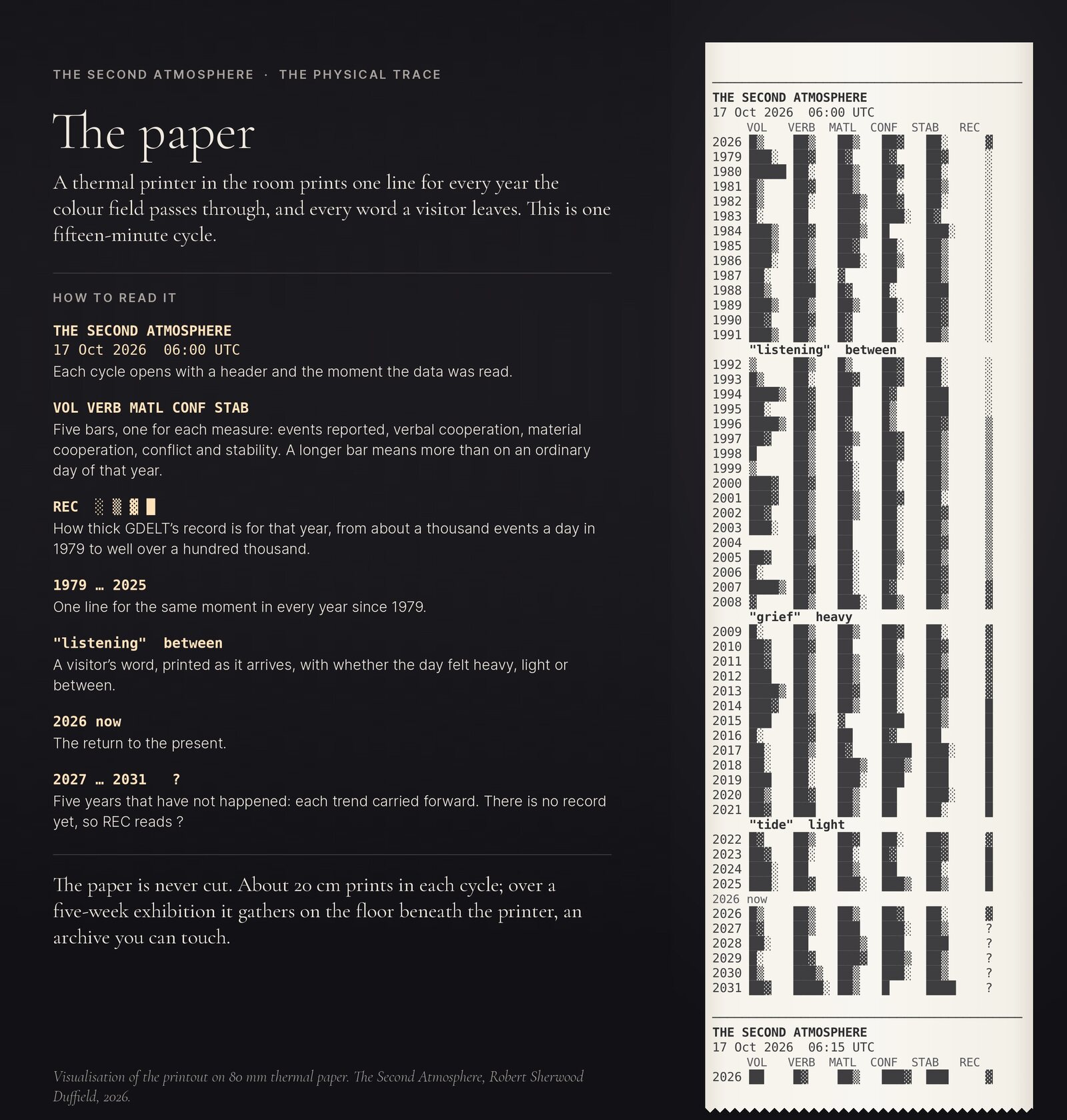
- The printer prints each word between the years as it arrives. The paper is never cut and gathers on the floor across the exhibition.
- Afterwards
- When the exhibition closes, the digital record is deleted and the paper becomes the only lasting copy of the visitors’ archive.
THE PAPER
THE WORK AND THE ARCHIVE
- An instrument of knowledge production
- Turning GDELT’s records into colour and density makes visible how collecting and classifying events shapes what is known, and how much the record left out.
- A site of critical intervention
- Visitors add first-hand experience to a system organised around reported public events. Their light runs through the machine archive’s gaps. This is the work’s central gesture.
- A space for alternative visions of the future
- After the present, each figure’s fifteen-year trend runs into five unrecorded years, uncertainty widening, until the image comes apart. Not a prediction: the limit of what an archive can say about what comes next. Beside it, the visitors’ archive grows, a record people are still writing.
IN THE ROOM
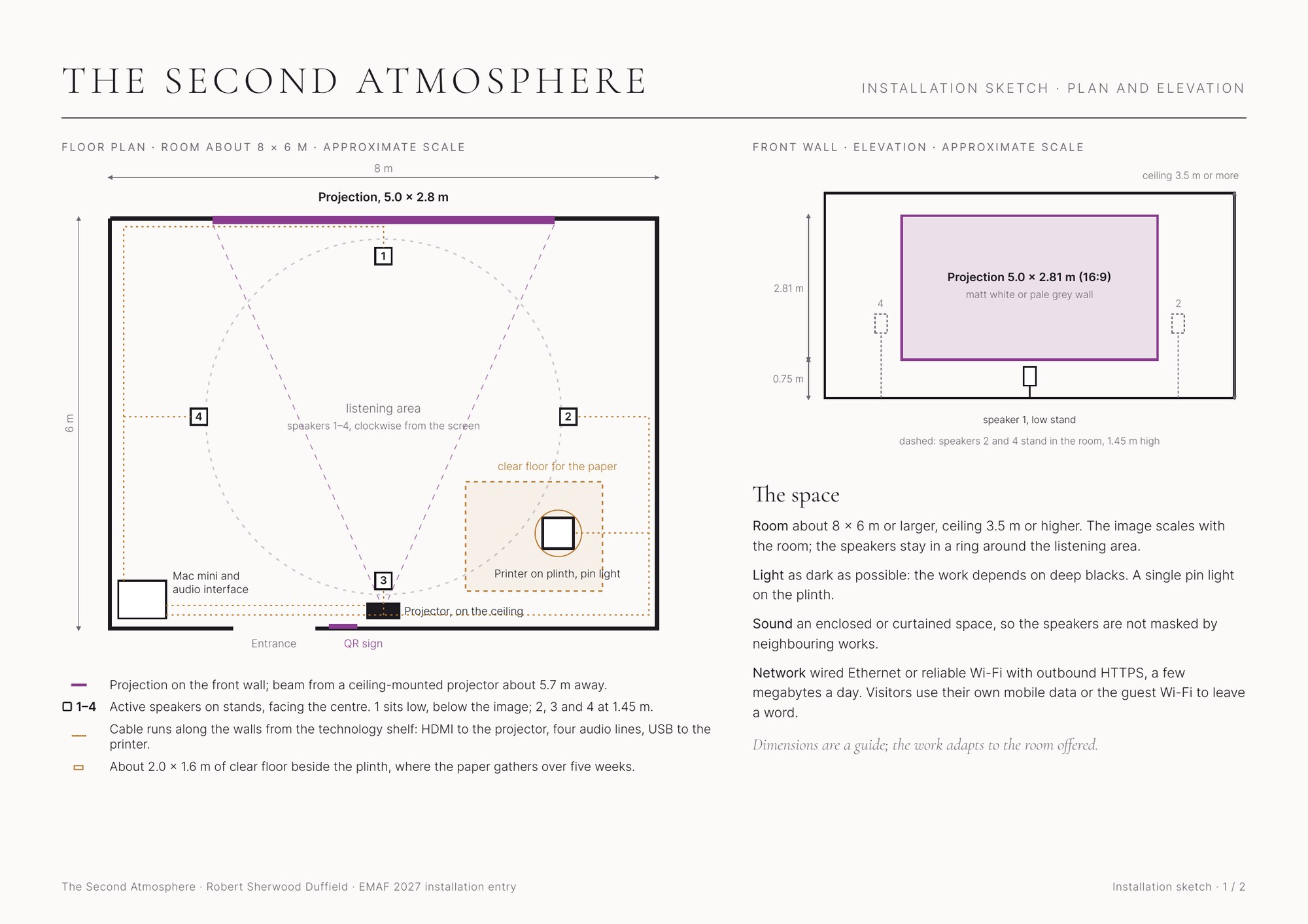
A darkened room holds one wall-sized projection, four speakers in a ring and a printer on a plinth. There is no map, text or news image, only the colour field. The sound is synthesised live from the same five figures, each voice in its own place in the ring: the foundation fills the room, others wander or circle, and conflict stays in one corner until it rises, then surrounds the listener. Visitors stand inside the sound, watch the years pass, and see their own word surface in the light.
INSTALLATION
One wall-sized projection, four speakers in a ring and a thermal printer on a plinth, run by a single computer from a web browser. The work runs unattended from opening to closing: switching the computer on is all that is needed to start it. If the network drops, it keeps running on its last data and returns to live data when the connection does. The paper roll is changed about every four days; the paper already on the floor stays where it falls for the whole exhibition.
DOCUMENTATION
One complete fifteen-minute cycle, recorded from the work with its sound.
DOCUMENTS
- Press kitPDF · 6 pages · 1.1 MB
- Technical riderPDF · 2 pages · 64 KB
- Installation sketch and schedulePDF · 2 pages · 97 KB
CREDITS
Concept, direction and artwork: Robert Sherwood Duffield
Data: The GDELT Project, gdeltproject.org
Typefaces: Cormorant Garamond and Inter
Images © Robert Sherwood Duffield